 Comunications
News
SELA commemorates 50 years promoting cooperation and integration in Latin America and the Caribbean
Comunications
News
SELA commemorates 50 years promoting cooperation and integration in Latin America and the Caribbean
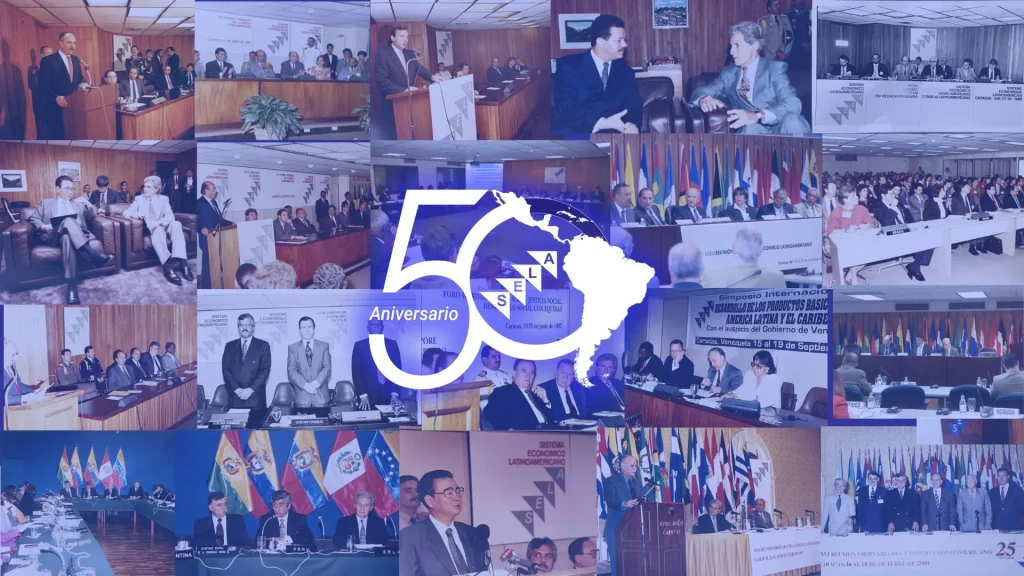
The Latin American and Caribbean Economic System (SELA) commemorates its 50th anniversary this October, an auspicious date to reaffirm its commitment to integration, intra-regional cooperation and the economic and social development of Latin America and the Caribbean.
SELA was established on 17 October 1975 through the signing of the Panama Convention in response to the need to create a permanent system for consultation, coordination and cooperation among the countries of the region. That historic agreement, signed by 24 sovereign Latin American and Caribbean States, laid down the principles of equality, sovereignty, solidarity, non-intervention and mutual respect, which continue to guide the work of the organisation half a century later.
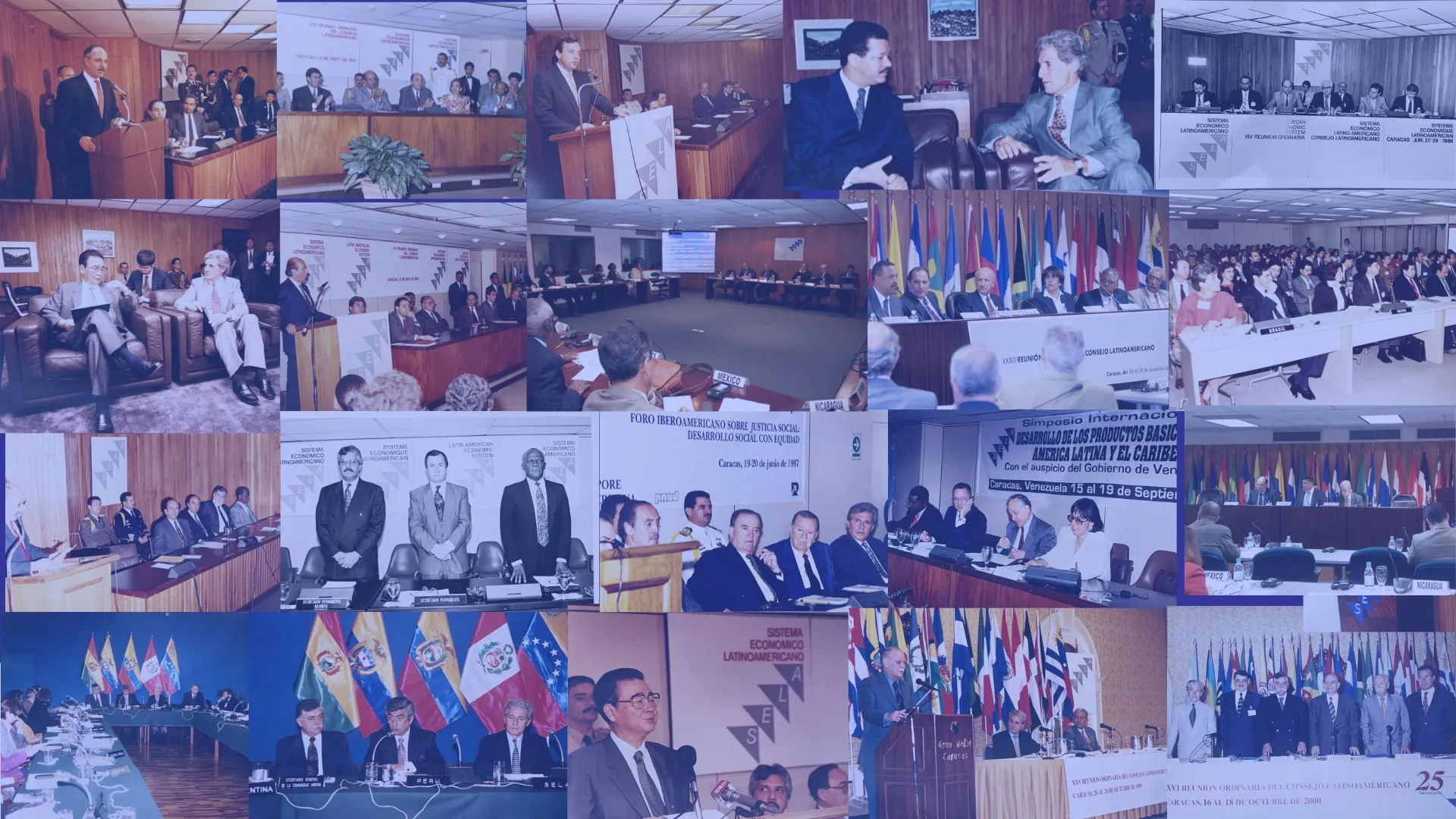
Over the past 50 years, SELA has been a regional benchmark in the coordination of public policies, the promotion of consensus and the strengthening of integration mechanisms. Its commitment to integration has been expressed in the development of a regional cooperation agenda, currently focused on three main areas: Economic Recovery, Digitalisation and Infrastructure, and Social Development, in line with the Sustainable Development Goals.
The Permanent Secretariat of SELA has been the technical driving force behind this work, transforming dialogue into action and building bridges for development. Under the guidance of 13 Permanent Secretaries, it has articulated a common voice to the world, generating strategic knowledge for the formulation of public policies, promoting South-South cooperation and leading innovation and adaptation initiatives in the face of the challenges of the 21st century.
One of SELA’s pillars has been the generation of technical knowledge. Over five decades, its publications have been an indispensable source of reference for universities, research centres and decision-makers. SELA’s books and studies address key issues of regional interest, such as artificial intelligence and its impact on public policy, technological governance, public procurement in Latin America and the Caribbean, South-South cooperation, regional economic integration, digital diplomacy, the circular economy, disaster risk management, sustainable development and the strengthening of SMEs.
In recent years, SELA has intensified its joint work with other regional mechanisms, consolidating an inter-secretariat agenda that promotes institutional convergence and technical cooperation. Through the Regional Convergence Matrix (MCR), areas for joint work have been identified, optimising resources and generating concrete solutions to shared challenges. This tool reflects a commitment to more mature, efficient and humane integration.
The joint effort has involved organisations such as the Latin American Integration Association (ALADI), the Andean Community (CAN), the Caribbean Community (CARICOM), the Common Market of the South (MERCOSUR), the Central American Integration System (SICA), the Amazon Cooperation Treaty Organisation (ACTO), the Association of Caribbean States (ACS), the Bolivarian Alliance for the Peoples of Our America – Peoples’ Trade Agreement (ALBA-TCP), the Pacific Alliance and the Community of Latin American and Caribbean States (CELAC).
Currently, under the leadership of Ambassador Lesly David, who was elected Permanent Secretary in June of this year, the organisation continues its strategic renewal process in order to respond to contemporary challenges in promoting a more resilient, convergent, and united region.
On this 50th anniversary, SELA reaffirms its mission to work towards a more integrated Latin America and the Caribbean, where regional cooperation is the driving force for overcoming structural gaps, promoting sustainable development and strengthening the region’s voice on the international stage.