 Events
IV Virtual Seminar on food security, boosting productivity and sustainability in Latin America and the Caribbean
Events
IV Virtual Seminar on food security, boosting productivity and sustainability in Latin America and the Caribbean


Food security represents one of the most complex structural challenges for Latin America and the Caribbean, in a context characterised by simultaneous pressures on agri-food systems resulting from climate change, market volatility, persistent territorial inequalities and the need to move towards environmentally sustainable production models. Although the region continues to play an important role as a global food supplier, significant gaps in access, stability and affordability of food remain, particularly among rural populations and lower-income households.
According to recent estimates, moderate or severe food insecurity affects more than a quarter of the region’s population, while the cost of a healthy diet remains the highest globally. These figures show that, despite the partial progress made in recent years, food security remains a structural challenge for Latin America and the Caribbean, closely linked to productive, environmental and socio-economic factors.
In this scenario, the problem can no longer be addressed solely through production expansion, but requires a comprehensive approach aimed at boosting agri-food productivity in a sustainable manner, understood as the ability to increase production and efficiency without compromising natural resources or expanding the agricultural frontier, while strengthening resilience to the impacts of climate change. Regional evidence indicates that recent agri-food growth has been largely associated with increased use of input rather than sustained improvements in total productivity, posing economic, social and environmental risks in the medium term.
Added to this are the growing effects of climate change, which are already impacting agricultural yields, supply stability and rural livelihoods, particularly in areas with high socio-economic vulnerability. As a result, sustainable productivity and climate resilience are becoming essential conditions for ensuring the region’s present and future food security.
At the same time, recent changes in the international environment are reshaping the incentives and requirements facing agri-food systems in Latin America and the Caribbean. The progress of the Association Agreement and the Interim Trade Agreement between the European Union and Mercosur introduces increasing demands in terms of sanitary and phytosanitary standards, environmental sustainability and traceability of production chains. Far from being merely a trade debate, these elements have direct implications for productivity, the organisation of value chains and the capacity of States to translate productive and export dynamism into effective food security outcomes.
Against this backdrop, regional cooperation emerges as a key enabler for strengthening institutional capacities, promoting regulatory convergence, improving the availability and use of information, and driving the adoption and scaling up of sustainable productive innovations.
In this regard, the Latin American and Caribbean Economic System (SELA), in compliance with its mandate in recent years, has created a progressive line of work on food security and agri-food systems, promoting spaces for analysis and dialogue aimed at identifying practical and replicable solutions to food security challenges in the region. In 2023, a space for analysis was promoted to examine the challenges of regional integration and cooperation in food security, with an emphasis on policy convergence and the reduction of vulnerabilities in distribution systems. Subsequently, in 2024, the work was deepened through a technical seminar focused on indicators for the comprehensive assessment of the vulnerability of agri-food systems, particularly in their commercial dimension, incorporating specialised contributions from international organisations. In 2025, this trajectory was expanded to include the analysis of technological modernisation, biotechnology and precision agriculture as tools for improving the productivity and sustainability of the regional agri-food sector.
In line with these priorities adopted under the Work Programme for 2026-2029 (D-4-25), Programme I Sustainable and Resilient Development, Project A Technical support for cooperation and sustainable development in Latin America and the Caribbean, Activity I entitled IV Virtual Seminar on food security, boosting productivity and sustainability in Latin America and the Caribbean as a regional technical space aimed at exploring how sustainable agri-food productivity, climate resilience and regional cooperation can effectively contribute to strengthening food security. The seminar will seek to provide analytical inputs and public policy guidance to advance towards more productive, sustainable and inclusive agri-food systems, capable of responding both to the internal needs of the region and to the demands of an increasingly complex international environment.
Food security in Latin America and the Caribbean has recently been characterised by partial progress in reducing hunger, coexisting with persistently high levels of food insecurity and difficulties in accessing healthy diets, confirming the structural and multidimensional nature of the challenge. The cumulative impacts of the pandemic, food inflation, market volatility and the effects of climate change continue to be high and heterogeneous, conditioning the performance of agri-food systems and the ability of households to ensure adequate nutrition.
According to the Regional Overview of Food Security and Nutrition in Latin America and the Caribbean 2024 (FAO et. al 2025), the prevalence of undernourishment (PoU)[1] in the region stood at 6.6% in 2022, falling to 6.2% in 2023, which showed a gradual recovery in terms of minimum food energy availability. Similarly, these estimates are consistent with those presented by the FAO (et al. 2024) in its SOFI 2024[2] report, which places regional PoU at around 6.1% for the period 2022–2023[3], confirming a stabilisation of the indicator at levels still higher than those observed before the pandemic.
The most recent update, contained in SOFI 2025 (FAO et al. 2025), shows that this downward trend continued in 2024, when the PoU reached 5.1% of the regional population. While this result represents significant progress, it continues to reflect the persistence of structural pockets of hunger in the region.
However, the favourable trend in undernourishment contrasts with the still high levels of moderate or severe food insecurity, as measured by the Food Insecurity Experience Scale (FIES)[4]. In 2023, this indicator affected 28.2% of the population of Latin America and the Caribbean, according to the Regional Panorama (2024), a figure that coincides with SOFI estimates (2024), which place moderate or severe food insecurity in the region at between 28 and 29%. In 2024, according to FAO (2025), there was a reduction to 23.3%, which is equivalent to more than one-fifth of the regional population. This difference between the improvement in PoU and the persistence of high levels of FIES shows that increased aggregate food availability does not automatically translate into stable and adequate access for large segments of the population.
One of the structural factors explaining this gap is the limited affordability of healthy diets, measured using the healthy diet cost indicator (HDCI)[5] and the share of the population that cannot afford a healthy diet. Under the same premise, Latin America and the Caribbean are identified as having the highest average cost in the world, estimated at USD 4.56 (PPP)[6] per person per day, exceeding the global average and that of other developing regions. As a result, 182.9 million people could not afford a healthy diet in 2023, according to FAO (et al. 2024). This situation continues in 2024, with an estimated 27.4% of the regional population, equivalent to approximately 180.3 million people, still lacking economic access to healthy food, according to FAO data (SOFI 2025). These data confirm that the challenge of food security in the region is closely linked to the interaction between food prices, household income, the structure of agri-food markets and public policies.
From a structural perspective, the productive performance of the agri-food sector reveals significant limitations in terms of sustainable productivity. Various analyses agree that agricultural growth in Latin America and the Caribbean has historically been sustained by the expansion of the use of inputs, land, water, fertilisers and energy. This has resulted in a pattern of more sustained increases in total factor productivity (TFP).[7] Between 2001 and 2020, the contribution of TFP to the growth of agricultural value added in Latin America and the Caribbean was lower than that observed in other developing regions, which increased pressure on natural resources and reduced the capacity of production systems to absorb external shocks. This pattern of extensive growth compromises the economic and environmental sustainability of the sector and directly affects the stability of food supply in the medium and long term.
International indicators for monitoring the Sustainable Development Goals reinforce this diagnosis. In particular, analysis of SDG indicator 2.4.1,[8] presented in the report Tracking progress on food and agriculture-related SDG indicators (FAO, 2025), shows that no country has fully met the criteria associated with agriculture that is simultaneously productive, resilient and environmentally sustainable. Latin America and the Caribbean are at an intermediate level of progress, with insufficient progress to meet the established targets, facing challenges such as soil degradation, inefficient use of water and nutrients, limited adoption of sustainable production practices, and gaps in technical and statistical capacities, particularly among small producers.
In addition to these structural constraints, the growing impacts of climate change are placing additional stress on agri-food systems. Recent scientific assessments indicate that rising average temperatures and the increased frequency and intensity of droughts, floods and extreme weather events are already causing yield losses in key crops and affecting livestock farming, especially in rain-fed agricultural systems and in areas with high socio-economic vulnerability. In the absence of adaptation measures, these impacts are expected to intensify, increasing the volatility of production, food prices and rural incomes, with direct effects on food security and livelihood stability.
At the same time, the international situation introduces additional elements that affect the region’s agri-food systems. The progress of the Association Agreement and the Interim Trade Agreement between the European Union and Mercosur, authorised for signature in 2026, consolidates a large-scale trade framework involving an exchange of goods worth more than EUR 110 billion (approx. USD 120 billion) and services worth over EUR 50 billion (approx. USD 55 billion) annually. This agreement incorporates commitments on trade and sustainable development, regulatory cooperation and quality standards, which directly affect the organisation, costs and competitiveness of agri-food chains.
From a technical perspective, this new environment reinforces the need to increase productivity sustainably, rather than expanding production volumes. The demands associated with traceability, environmental management and transparency in production chains pose significant challenges for countries and producers in the region, particularly for smaller-scale producers, who face gaps in technical, institutional and financial capacities. Without adequate public policies and cooperation mechanisms, these demands may deepen asymmetries and limit the capacity of agri-food systems to contribute effectively to domestic food security.
The available evidence shows that strengthening the international integration of agri-food systems does not, on its own, guarantee improvements in food security. It is possible to observe the coexistence of dynamic exports with high levels of food insecurity, low rural incomes and high vulnerability to external shocks. Hence the need to align productivity, sustainability and trade strategies with explicit objectives of food security, inclusive rural development and climate resilience, through integrated and data-driven approaches.
In this context, regional cooperation plays a strategic role in addressing challenges that transcend national capacities. Strengthening sustainable productive capacities, improving information and measurement systems, regulatory convergence, and the exchange of practices and innovations require coordinated responses. From this perspective, addressing food security in Latin America and the Caribbean requires regional technical spaces that allow for a deeper analysis of existing structural and cyclical gaps and generate public policy guidelines based on evidence and comparative experiences.
[1] The Prevalence of Undernourishment (PoU) is the main global indicator for measuring hunger, which forms part of the United Nations monitoring framework. Specifically, it is the official indicator 2.1.1 within Sustainable Development Goal (SDG) 2. It is measured using a statistical model that estimates the probability that the usual caloric intake of a person in that population is insufficient to meet their minimum energy needs, based on total food availability and distribution.
[2] The State of Food Security and Nutrition in the World (SOFI) is a report published annually by FAO and partner agencies, which monitors progress towards Zero Hunger and analyses the costs of healthy diets at global and regional levels.
[3] It should be noted that the figures are presented as rounded point estimates rather than single values, falling within a confidence interval ranging from 5.9% to 6.3% (FAO et al. 2025).
[4] The Food Insecurity Experience Scale (FIES) is the FAO’s standard metric for measuring the severity of food insecurity through people’s direct perceptions. It is calculated using an eight-question questionnaire that asks about experiences of resource deprivation (e.g., food concerns, reduced quality or quantity, and extreme hunger). Statistically, these responses are processed using the Rasch Model, which converts qualitative data into a globally comparable quantitative scale. This system is the official indicator 2.1.2 of the Sustainable Development Goals (SDGs), designed to monitor the fulfilment of Target 2.1 of the 2030 Agenda, which aims to eradicate hunger and ensure physical and economic access to nutritious food (FAO et al. 2025).
[5] The CoHD assesses the affordability of a nutritious 2,330 kcal diet by calculating the lowest local price of six essential food groups defined by the Dietary Guidelines (GABA). As a tool for monitoring SDG Target 2.1, this indicator makes it possible to identify whether food insecurity is due to a lack of physical availability of products or insufficient household income (FAO et al. 2025).
[6]Purchasing power parity (PPP) is the exchange rate at which one country’s currency would have to be converted into another country’s currency to purchase the same amount of goods and services in each country. Source: IMF, Guide to Purchasing Power Parity.
[7]Total Factor Productivity (TFP) is defined as the ratio between a measure of output volume and a measure of combined input volume. It is usually conceived as the component of output growth that cannot be explained by growth in inputs (capital and labour), reflecting efficiency and technological change. Source: OECD (2001), OECD Manual on Productivity Measurement.
[8]Indicator 2.1.4 measures the share of agricultural land devoted to productive and sustainable agriculture under economic, environmental and social dimensions. Due to the complexity of obtaining global data, the FAO currently uses a proxy measure based on seven metrics (such as production value, nitrogen efficiency and water stress) to monitor progress towards Target 2.4, which seeks to ensure resilient and sustainable food production systems (FAO, 2025).
IV Virtual Seminar on food security, boosting productivity and sustainability in Latin America and the Caribbean
Format: Virtual.
Participants: FAO; CELAC; CAF; WFP; IFAD; EU; IICA (to be confirmed).
Language: Spanish, with simultaneous interpretation into English.
Date: 25 February 2026.
ZOOM registration link:
https://us06web.zoom.us/webinar/register/WN_wSK3pDyqTzuS6zDaqnW_mw
Time: 10:30 – 13:20 local time in Caracas, Venezuela.
For further information, please contact the Latin American and Caribbean Economic System (SELA)
|
IV Virtual Seminar on food security, boosting productivity and sustainability in Latin America and the Caribbean |
|
| Wednesday, 25 February 2026 | |
| Time | Activity |
| 10:30 – 10:40 h | Opening of the discussion:
|
| SELA Moderator
Luis Emilio Martínez, Analyst, Area of Social Development |
|
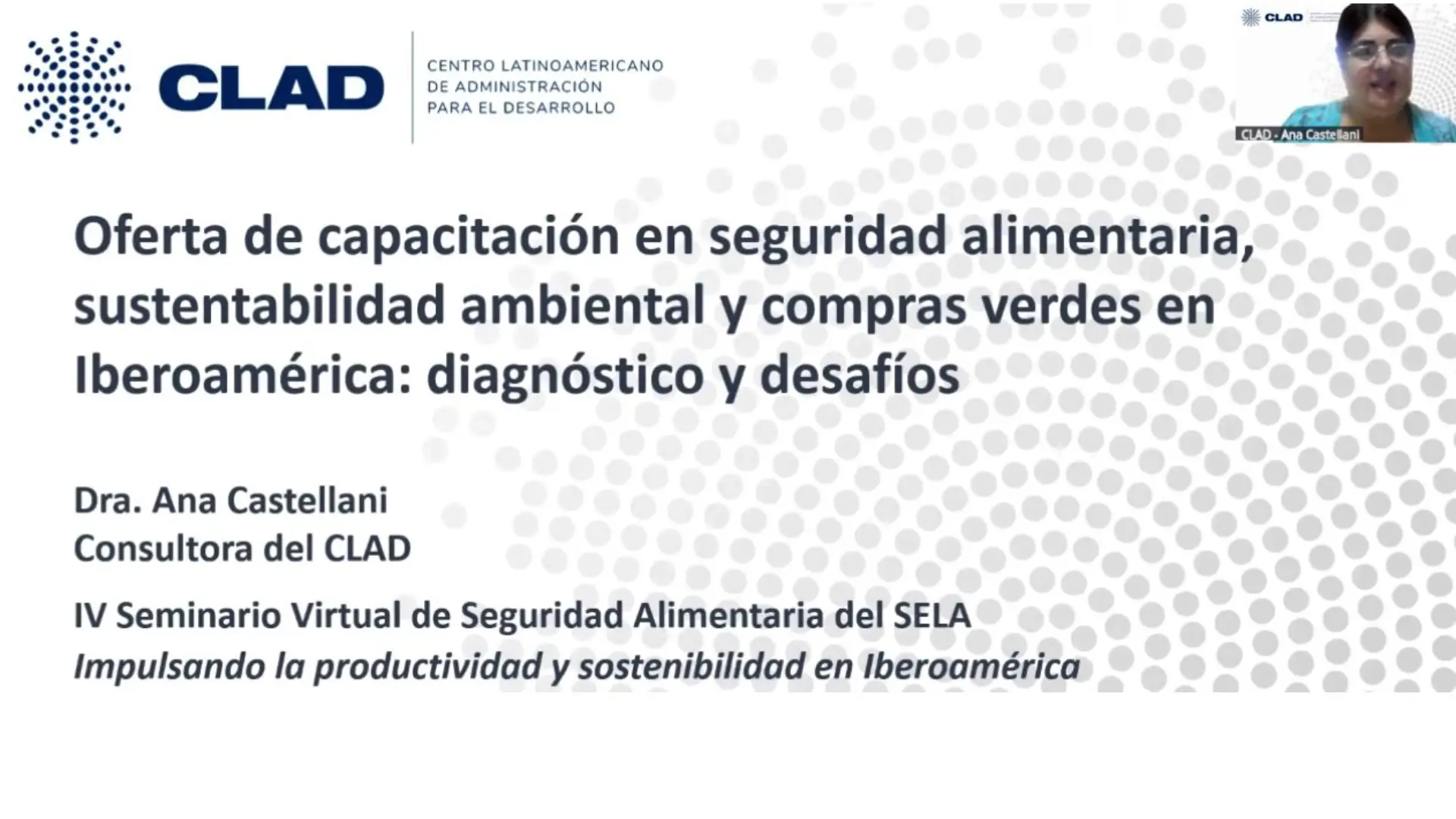
| 10:40 – 11:05 h | PANEL I. “Training offer in food safety, environmental sustainability and green procurement in Iberoamerica: diagnosis and challenges”.
|
| 11:05– 11:30 h | PANEL II
|
| 11:30 – 11:55 h | PANEL III
|
| 11:55 – 12:20 h | PANEL IV
|
| 12:20 – 12:35 h | Questions and answers |
| 12:35 – 13:00 h | Closing remarks |




 Information